
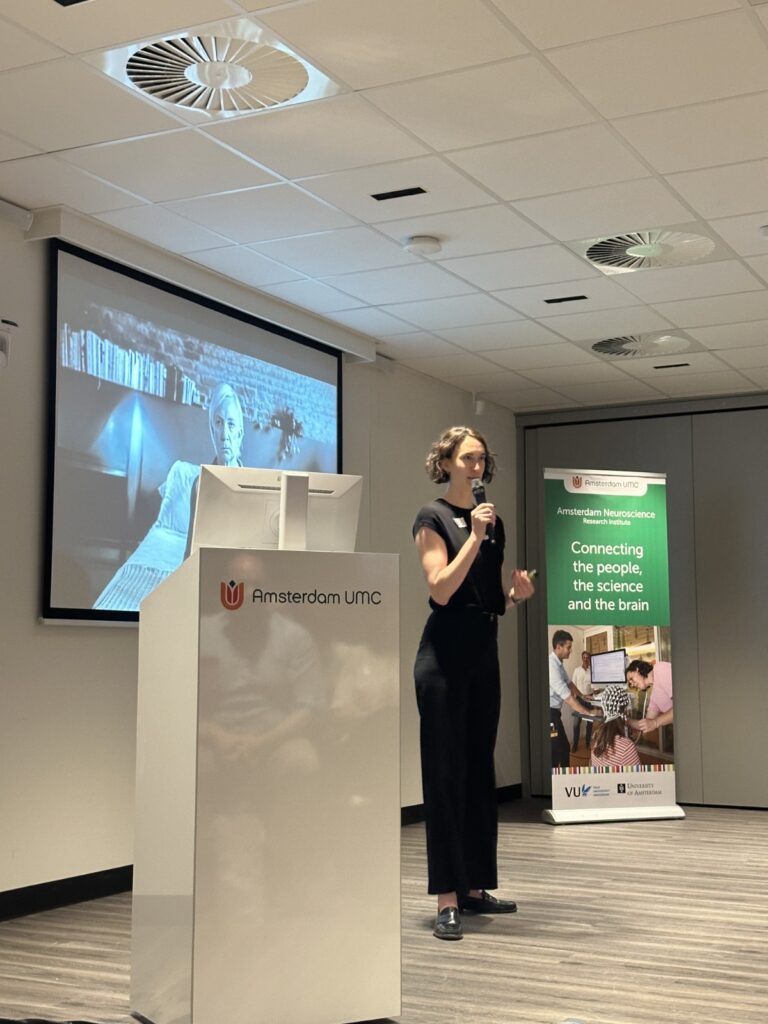
The Person Behind Row 214
Eva Koderman — PhD candidate, Amsterdam UMC (MULTINET lab)
Somewhere on my work computer is a spreadsheet with a few thousand rows. Age. Tumor location. Surgery date. Walking ability at twelve months. To run my models, I have to treat these as numbers. But behind row 214 is someone who woke up from surgery and had to relearn, day by day, what her body could still do.
I’m a PhD candidate at Amsterdam UMC, working in the MULTINET lab, where we try to deepen our understanding of glioma — a brain cancer that originates in the glial cells.
My work has two parts. The first is developing prediction models that could eventually be used in the clinic as decision-support tools, helping clinicians answer questions like: If this patient undergoes surgical removal of their tumor, will they be functionally okay a year later? Will they be able to walk? Return to work?
The second is building digital twins — mathematical models that simulate brain dynamics. The hope is that these digital twins will empower clinicians to better understand how an individual’s brain dynamics might reshape after tumor removal, and how that, in turn, could affect their cognition. Together, this work is a step toward precision medicine, where every patient gets the individualized care they deserve.
Most of my days look nothing like a hospital. No white coat, no patients in front of me — just a screen and a lot of code. It’s easy for the person behind row 214 to fade into the background of a model. I try to keep her in view. That’s what makes the work worthwhile: the possibility that it leads somewhere useful for her.
And yet each patient’s disease, biology, and path through treatment is different. What should be common to all of them is equal access to clinical trials, and to the answers those trials produce. That’s part of why initiatives like this one matter to me: the more patients who sign this, the more complete a picture we get of who’s out there and what they need, and the better the chance that a trial actually finds the people it was designed for, not just the ones lucky enough to be treated at the right hospital. That’s the real long-term goal — not just better models, but a research system that actually reaches every patient, wherever they are.